ƒ
Formula-first handbook
Clean equations, assumptions, worked interpretation, and risk-manager language for PD, LGD, EAD, EL/UL, capital, migration, CVA, and ECL.
A rigorous handbook and runnable Python suite for learning, teaching, validating, and prototyping modern credit risk workflows—from a single exposure to portfolio loss and counterparty risk.
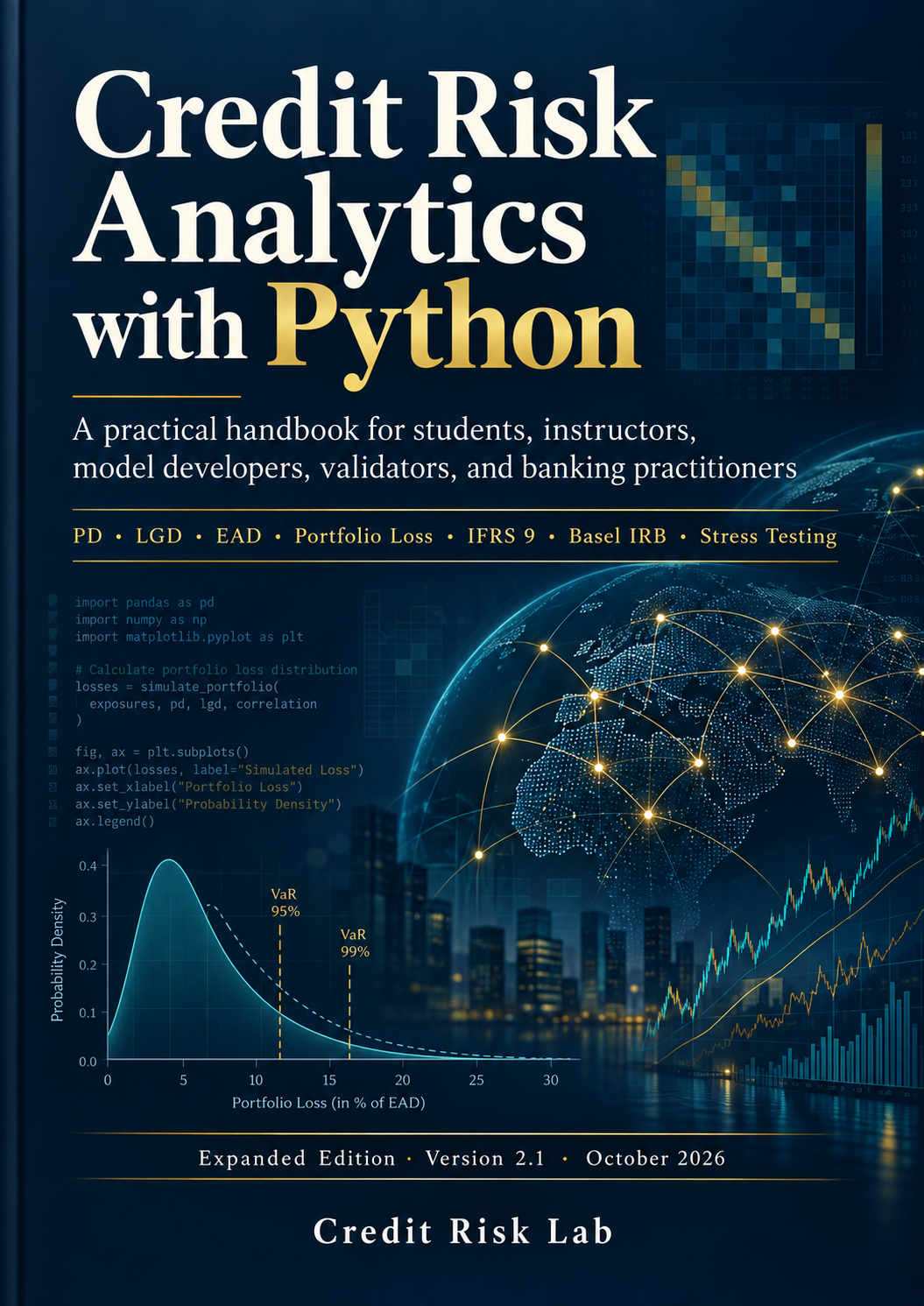
Built as a connected reference—not a folder of unrelated snippets. The handbook explains each model, the labs make it run, and the package turns the calculations into reusable components.
Clean equations, assumptions, worked interpretation, and risk-manager language for PD, LGD, EAD, EL/UL, capital, migration, CVA, and ECL.
An end-to-end workflow plus 18 guided labs. Execute them as scripts or in notebook-aware editors and inspect every intermediate result.
Installable modules for portfolio loss, PD, LGD, EAD, dependence, stress, IFRS 9, ratings, credit derivatives, and counterparty risk.
Discrimination, calibration, stability, drift, numerical tests, data contracts, and reproducible run manifests support review—not just model fitting.
Snapshot inputs, reconcile balances, separate calibration from application, document overrides, preserve evidence, and respect change controls.
Course mapping, exercises, solutions, assignments, rubrics, formula reference, cookbook, and a full glossary for classroom or self-study.
The suite bundles dated, offline snapshots from authoritative public sources so examples remain reproducible while students learn proper provenance, metadata, licensing, and as-of discipline.
The sequence mirrors how mature risk teams separate data, methodology, validation, scenario application, reporting, and governance.
Start with target definitions, observation windows, defaults, cures, recoveries, and a dated source snapshot.
Develop transparent benchmark models, then calibrate to documented long-run, point-in-time, or downturn targets.
Test more than headline accuracy: calibration, stability, concentration, tail behavior, sensitivity, and limitations all matter.
Preserve reproducible outputs and distinguish model results from overlays, policy rules, and expert decisions.
Every core relationship is explained in the handbook and mirrored by transparent Python—not hidden behind a black-box API.
The starting identity for pricing, provisioning, portfolio analysis, and control reconciliation.
A compact bridge from obligor default risk to systematic-factor portfolio loss.
Connects discounted expected exposure, default increments, and recovery assumptions.
Read it linearly as a course, teach it as a structured module, or use individual components as transparent benchmark and challenger implementations.
Move from credit-risk foundations to advanced portfolio methods without losing the intuition behind the equations.
Start with the free handbook →Use the course map, guided labs, exercises, formula reference, and transparent datasets for demonstrations and assignments.
See the complete teaching pack →Adapt tested building blocks for training, benchmarking, challenger work, and method review within your institution's controls.
Inspect the premium code suite →The handbook integrates the original Measurement of Credit Risk syllabus with advanced institutional topics from model development, markets, counterparty risk, and governance.
The PDF is the free learning edition. The premium suite is a separate paid product containing the installable package, real-data snapshots, guided labs, tests, configurations, documentation, and reproducible examples behind the book.